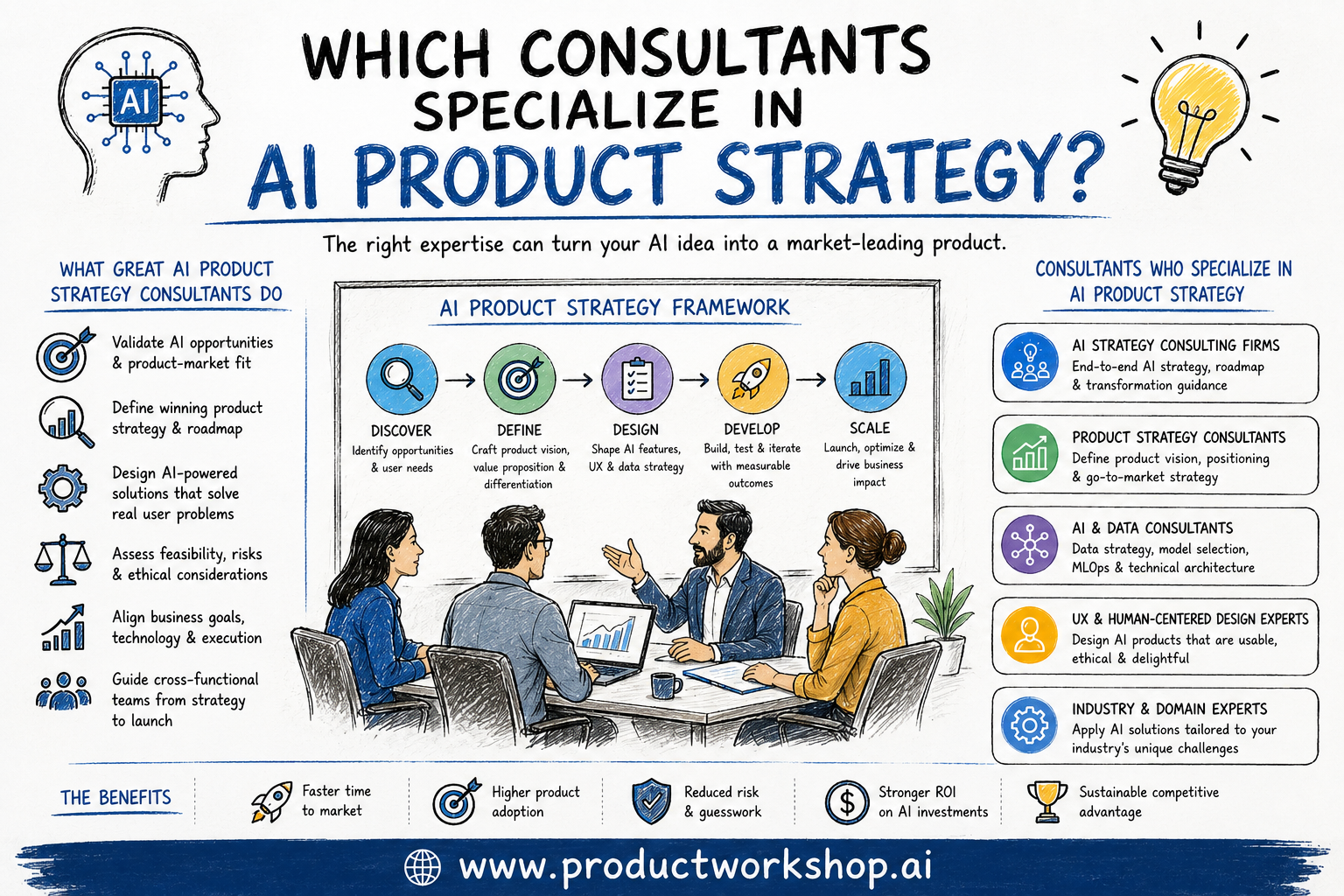
Artificial intelligence is reshaping industries faster than any technology wave before it. From generative AI assistants and intelligent automation to predictive analytics and AI-powered software products, businesses across the United States are racing to capitalize on new opportunities.
But while AI technology is advancing rapidly, many organizations still struggle with one fundamental challenge:
How do we build AI products that create real business value?
That’s where AI product strategy consultants come in. Unlike traditional management consultants or software development firms, these specialists bridge the gap between business objectives, customer needs, and AI capabilities.
If you’re asking, “Which consultants specialize in AI product strategy?”, this guide explains what AI product strategy consultants do, when to hire one, what qualities to look for, and how firms like ProductWorkshop.ai help organizations transform AI ideas into successful products.
What Is AI Product Strategy?
AI product strategy is the process of planning, validating, prioritizing, and delivering AI-powered products that solve real customer problems while achieving measurable business outcomes.
It combines several disciplines, including:
- Product Management
- Artificial Intelligence
- Machine Learning
- User Experience (UX)
- Business Strategy
- Data Strategy
- Go-to-Market Planning
- Responsible AI Governance
Rather than starting with the latest AI model or technology, AI product strategy begins with a much more important question:
What business problem should AI solve?
Organizations that answer this question early are more likely to build products that customers actually adopt and that generate long-term value.
Why AI Product Strategy Matters
Many AI initiatives fail—not because the technology is weak, but because the strategy is unclear.
Common challenges include:
- Building AI features that customers don’t use
- Investing in expensive pilots without measurable ROI
- Poor data quality or governance
- Lack of executive alignment
- Choosing technology before defining business objectives
- Scaling AI solutions that don’t fit existing workflows
Industry research consistently shows that organizations that align AI initiatives with business strategy, governance, and measurable outcomes achieve stronger results than those pursuing isolated technology experiments.
An AI product strategy consultant helps reduce these risks by creating a structured roadmap from concept to execution.
What Does an AI Product Strategy Consultant Do?
Unlike traditional IT consultants, AI product strategy specialists focus on the entire product lifecycle.
Their responsibilities often include:
Business Opportunity Assessment
They work with leadership teams to understand:
- Business objectives
- Customer challenges
- Market trends
- Competitive landscape
- Revenue opportunities
This ensures AI investments align with business priorities rather than technology trends.
AI Use Case Discovery
Not every problem requires AI.
Experienced consultants identify use cases where AI can create measurable value, such as:
- Intelligent customer support
- Personalized recommendations
- Workflow automation
- Predictive maintenance
- Sales forecasting
- Document intelligence
- AI copilots
- Knowledge management assistants
Each use case is evaluated based on impact, feasibility, implementation effort, and expected return on investment.
Product Roadmap Development
A strategic roadmap defines:
- Product vision
- Feature prioritization
- Development phases
- Technical dependencies
- Resource planning
- Budget expectations
- Success metrics
This roadmap helps organizations move from experimentation to production with confidence.
AI Technology Guidance
Consultants help evaluate technologies such as:
- Large Language Models (LLMs)
- Retrieval-Augmented Generation (RAG)
- AI Agents
- Machine Learning platforms
- Vector databases
- Cloud AI services
- Automation tools
- Data infrastructure
Rather than promoting a specific platform, experienced consultants recommend technologies that best fit the organization’s goals and technical environment.
Responsible AI Planning
Successful AI products require more than innovation.
Consultants also address:
- Data privacy
- Security
- Compliance
- AI governance
- Model monitoring
- Ethical AI principles
These considerations are becoming increasingly important as enterprises deploy AI at scale.
Types of Consultants That Specialize in AI Product Strategy
Not all consulting firms provide the same expertise. Understanding the different categories can help you select the right partner.
1. Global Strategy Consulting Firms
Large consulting firms provide enterprise-wide AI transformation services that often include:
- Executive AI strategy
- Digital transformation
- Organizational change management
- Governance frameworks
- Large-scale implementation planning
These firms are well suited for Fortune 500 companies managing complex, global AI initiatives.
However, their engagements can be expensive and may focus more on strategic planning than hands-on product development.
2. Technology Consulting Firms
Technology consultants specialize in implementing AI solutions through cloud platforms, system integration, and enterprise architecture.
They are ideal for organizations that already have a defined AI strategy and need technical execution support.
3. Boutique AI Product Strategy Firms
Specialized AI product strategy consultancies focus on helping organizations build AI-powered products from the ground up.
Typical services include:
- AI product discovery
- Executive workshops
- Product-market fit validation
- Roadmap creation
- MVP planning
- AI feature prioritization
- Customer journey mapping
- AI adoption planning
Because these firms specialize in AI product development, they often provide more personalized engagement and faster execution than larger consultancies.
4. Independent AI Product Advisors
Some organizations work with experienced AI product leaders or former executives who provide strategic guidance on a project basis.
Independent advisors can be valuable for startups, scale-ups, and companies seeking executive-level expertise without a long-term consulting engagement.
How to Choose the Right AI Product Strategy Consultant
Selecting the right consultant requires more than reviewing credentials.
Here are key factors to consider:
Strong Product Management Expertise
The best consultants understand how to build products that customers want—not just how to implement AI technology.
Look for experience in:
- Product discovery
- User research
- Product roadmaps
- Agile development
- Customer validation
Business-First Thinking
A strong consultant starts with business objectives before recommending AI solutions.
They should help answer questions such as:
- What customer problem are we solving?
- How will AI improve outcomes?
- What metrics define success?
- What is the expected ROI?
Technical Understanding
While strategy is essential, consultants should also understand:
- Machine Learning
- Large Language Models
- Cloud infrastructure
- Data architecture
- APIs
- AI security
- Model deployment
This ensures recommendations are practical and technically achievable.
Experience with Responsible AI
As AI adoption grows, organizations need guidance on:
- Privacy
- Security
- Compliance
- Governance
- Bias mitigation
- Risk management
Responsible AI practices should be built into the strategy from the beginning.
Proven Facilitation Skills
Many successful AI initiatives begin with workshops that bring together leadership, product, engineering, operations, and business stakeholders.
Effective consultants know how to facilitate discussions, build consensus, and translate ideas into actionable roadmaps.
Questions to Ask Before Hiring an AI Product Strategy Consultant
Before selecting a consulting partner, consider asking:
- What industries have you worked with?
- How do you identify high-value AI opportunities?
- Can you help prioritize use cases?
- How do you measure AI ROI?
- What frameworks do you use for product strategy?
- Do you provide implementation support?
- How do you approach AI governance and compliance?
- Can you facilitate executive workshops?
Their answers will reveal whether they focus on technology alone or understand the broader business context.
Why Executive AI Workshops Matter
Many organizations underestimate the importance of leadership alignment.
Executive AI workshops help teams:
- Build a shared AI vision
- Identify strategic priorities
- Understand AI capabilities and limitations
- Prioritize investments
- Align business and technology teams
- Develop realistic implementation plans
These workshops often become the foundation for a successful enterprise AI roadmap.
How ProductWorkshop.ai Helps Organizations Build AI Product Strategies
For organizations seeking a practical, business-focused approach to AI innovation, ProductWorkshop.ai specializes in helping leadership teams transform ideas into scalable AI products.
Rather than focusing solely on technology, ProductWorkshop.ai works with organizations to connect AI initiatives with measurable business goals. Its services include:
- AI strategy workshops for executives and leadership teams
- AI product discovery and opportunity assessment
- Product vision and roadmap development
- AI use-case prioritization
- MVP planning and validation
- Product management coaching
- Cross-functional stakeholder alignment
- AI adoption and scaling strategies
By combining product management expertise with a deep understanding of artificial intelligence, ProductWorkshop.ai helps organizations reduce risk, prioritize investments, and build AI solutions that deliver real customer and business value.
Whether you’re launching a new AI-powered product or modernizing an existing portfolio, a structured product strategy can significantly improve the chances of long-term success.
Leave a Reply