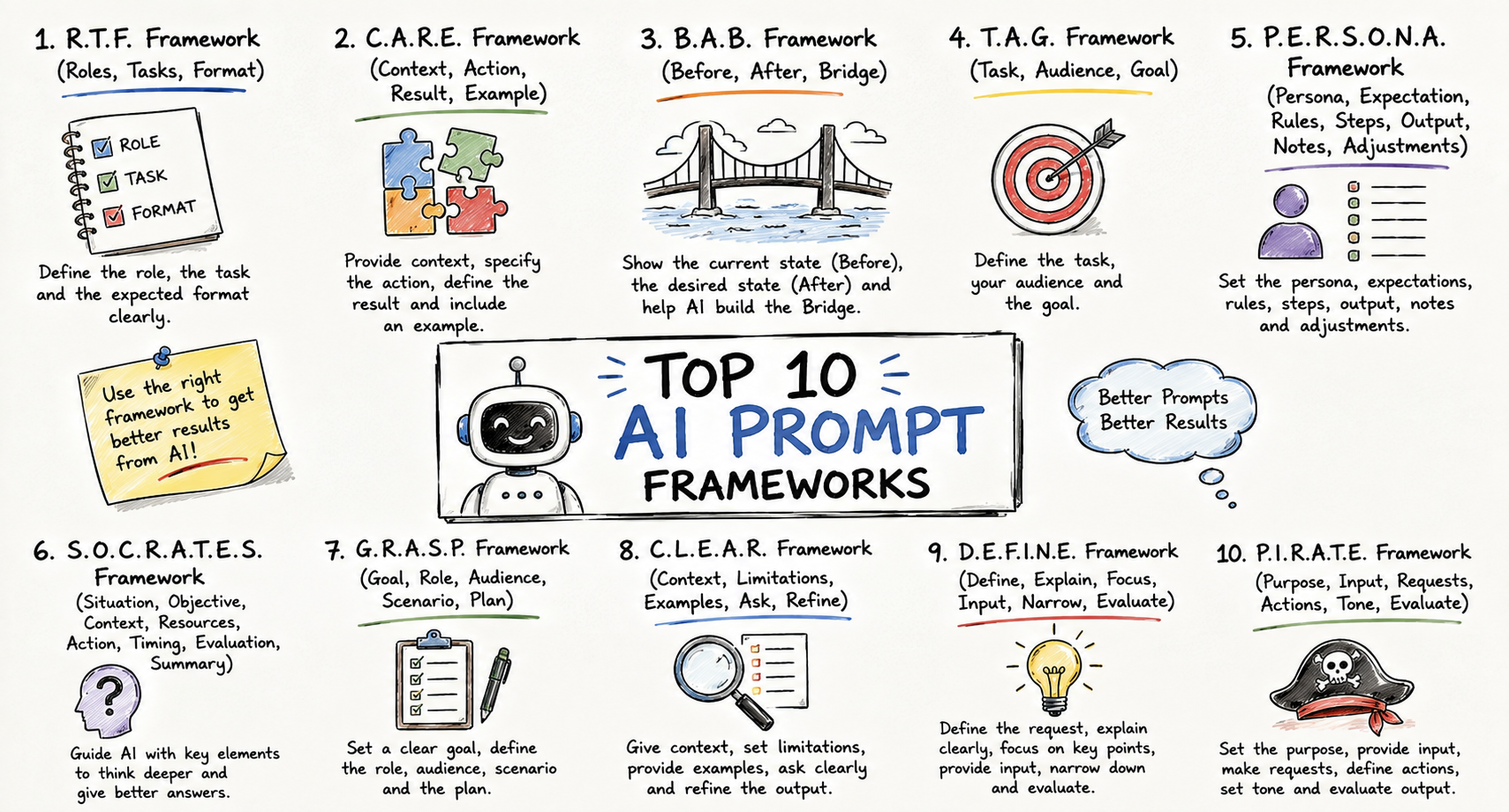
Artificial intelligence has become an essential business tool across the United States. From generating marketing campaigns and writing software code to summarizing research and analyzing business data, AI is helping organizations save time and work more efficiently. Yet, many users still struggle to get consistently high-quality results.
The difference often comes down to how the prompt is structured.
Instead of writing random instructions, experienced AI users rely on prompt frameworks—proven structures that organize requests in a way AI models can better understand. A good framework provides context, clarifies expectations, and guides the model toward more accurate, useful, and actionable responses.
In this guide, we’ll explore the top 10 AI prompt frameworks, explain when to use them, and share practical examples that businesses, marketers, developers, educators, and entrepreneurs can apply immediately.
What Is an AI Prompt Framework?
An AI prompt framework is a structured method for communicating with a large language model (LLM). Rather than asking a broad question, the framework breaks your request into logical components such as:
- Role
- Context
- Objective
- Constraints
- Audience
- Desired output
- Examples
- Success criteria
This structure reduces ambiguity and often produces more reliable results.
Think of prompt frameworks as templates for effective communication with AI.
Why Prompt Frameworks Matter
A well-designed framework can help you:
- Produce more accurate responses
- Reduce repetitive editing
- Improve consistency across teams
- Save time on routine tasks
- Generate content tailored to specific audiences
- Make AI outputs easier to review and refine
Whether you’re using ChatGPT, Claude, Gemini, Microsoft Copilot, or another generative AI tool, prompt frameworks provide a repeatable process that scales across different use cases.
1. RACE Framework
RACE stands for:
- Role
- Action
- Context
- Expectation
Example
Act as a cybersecurity consultant. Explain how small businesses in the USA can improve email security. Include practical recommendations and present the information as a beginner-friendly guide.
Best For
- Blog writing
- Business advice
- Marketing content
- Technical explanations
Why it works: The framework clearly defines the AI’s role, task, background information, and expected output.
2. CRISPE Framework
CRISPE includes:
- Capacity
- Role
- Insight
- Statement
- Personality
- Experiment
This framework encourages richer context and style guidance.
Example
You are an experienced HR consultant. Explain hybrid workplace policies for medium-sized U.S. companies using a professional but approachable tone. Include examples and practical implementation steps.
Best for strategic reports and consulting-style responses.
3. COAST Framework
COAST stands for:
- Context
- Objective
- Actions
- Style
- Tone
Example
Context: A SaaS startup is launching a project management platform. Objective: Create a product announcement. Style: Professional and engaging. Tone: Optimistic. Include a call to action for business customers.
Ideal for marketing and communication teams.
4. CARE Framework
CARE consists of:
- Context
- Action
- Result
- Evaluation
Example
Analyze our customer support process, recommend improvements, explain expected outcomes, and suggest metrics for measuring success.
Useful for operational planning and process improvement.
5. SMART Prompt Framework
Inspired by SMART goal setting:
- Specific
- Measurable
- Achievable
- Relevant
- Time-bound
Example
Develop a 90-day social media strategy for a U.S.-based e-commerce business aiming to increase LinkedIn engagement by 25%. Include weekly milestones and KPIs.
Excellent for planning and project management.
6. Persona-Based Prompting
This approach assigns AI a specific professional identity.
Example
Act as an experienced CPA advising small businesses in California. Explain quarterly tax planning using plain English.
Other persona examples include:
- Software architect
- Product manager
- Legal analyst
- Marketing director
- Healthcare consultant
- Financial advisor
Giving AI a clear role often results in more focused and relevant responses.
7. Few-Shot Prompting
Instead of only describing the task, provide examples of the desired output.
Example
Input:
Example Review:
“Excellent customer service, fast shipping, and quality packaging.”
Desired Style:
Friendly, concise, and balanced.
Now write a review for this new product using the same style.
Few-shot prompting is particularly effective for:
- Content writing
- Classification
- Data formatting
- Customer support
8. Chain-of-Thought Style Structuring
For complex tasks, it’s often helpful to ask the model to break down a problem into logical stages or explain its reasoning process where appropriate, rather than expecting a single-step answer.
Example
Compare three CRM platforms for a U.S. manufacturing company. Evaluate pricing, features, integrations, scalability, and support before making a recommendation.
This structure works well for business analysis and decision support.
9. Output Format Framework
Sometimes the most important instruction is how the information should be presented.
Example
Create a comparison table followed by a bullet-point summary and a three-step action plan.
Possible output formats include:
- Tables
- FAQs
- Checklists
- JSON
- Executive summaries
- Reports
- Slide outlines
Specifying the format reduces the need for manual editing.
10. Iterative Refinement Framework
Professional AI users rarely stop after the first response. They refine the output through a series of focused follow-up prompts.
Example Workflow
Prompt 1:
Write a 1,200-word blog article.
Prompt 2:
Simplify the language for small business owners.
Prompt 3:
Add SEO headings.
Prompt 4:
Include three real-world examples.
Prompt 5:
Improve the conclusion with a stronger call to action.
This iterative approach often produces significantly better results than relying on a single prompt.
There is no single “best” framework. The right choice depends on your goals, audience, and desired output.
Best Practices for Prompt Engineering
To get the most from any framework:
- Clearly define the objective.
- Provide relevant business context.
- Identify the target audience.
- Specify the desired tone.
- Request a preferred output format.
- Include constraints such as word count or deadlines.
- Offer examples whenever possible.
- Review and refine AI-generated responses before publishing.
Prompt engineering is an iterative skill that improves with practice.
Recommended Resource: LLMRecommend.com
If you’re researching AI models, learning prompt engineering techniques, or comparing leading generative AI platforms, LLMRecommend.com is a valuable resource. The website publishes practical guides, AI tool comparisons, prompt ideas, and educational content to help professionals, businesses, and developers make informed decisions.
Whether you’re selecting an LLM for content creation, coding, customer service, research, or enterprise workflows, LLMRecommend.com provides insights that can support your AI adoption strategy.
About Agency References and Homepage Screenshots
If you include AI consulting firms, implementation partners, or agencies in your content, it’s best practice to:
- Link directly to each agency’s official website.
- Use homepage screenshots only if you have permission or your use complies with applicable copyright laws and the site’s terms of use.
- Credit the original source of any screenshots.
This helps readers explore additional resources while respecting intellectual property rights.
Leave a Reply