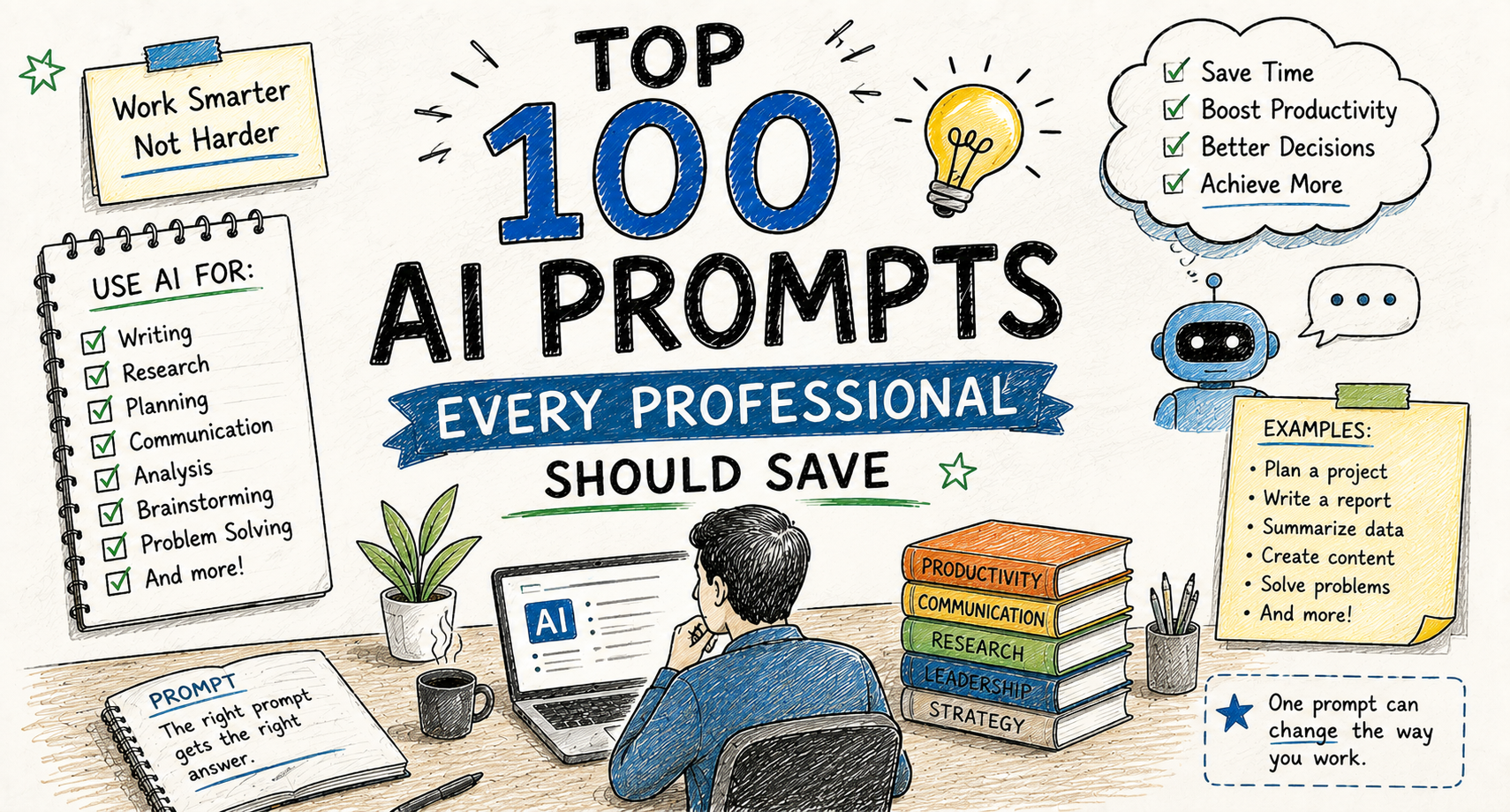
Work Smarter, Save Time, and Get Better Results with AI
Target Audience: Professionals, business owners, marketers, consultants, project managers, HR leaders, sales teams, entrepreneurs, freelancers, students, and executives across the United States.
Top 100 AI Prompts Every Professional Should Save in 2026
Artificial intelligence has become one of the most valuable workplace tools of the decade. Whether you’re writing emails, managing projects, researching competitors, preparing presentations, analyzing data, or brainstorming ideas, AI can help you complete tasks more efficiently and focus on higher-value work.
However, there’s one important truth that many professionals overlook: the quality of AI-generated results depends on the quality of the prompt.
A vague request often produces a vague answer. A clear, detailed prompt gives AI the context it needs to generate useful, accurate, and actionable responses.
As organizations across the United States continue to integrate AI into their daily workflows, prompt engineering is quickly becoming a practical business skill. You don’t need to be a programmer to benefit—learning how to ask better questions can improve productivity, communication, planning, and decision-making.
This guide brings together 100 carefully crafted AI prompts that professionals can adapt for everyday work. Whether you’re using ChatGPT, Claude, Gemini, Perplexity AI, or Microsoft Copilot, these prompts can help you streamline routine tasks while maintaining quality and consistency.
Why Every Professional Should Learn Prompting
AI tools have evolved far beyond simple chatbots. Today they assist with drafting documents, summarizing reports, planning projects, generating ideas, analyzing information, translating content, and automating repetitive work.
Professionals who know how to provide clear instructions often save hours each week. Instead of starting every document from scratch, they use AI to generate a strong first draft, organize information, or identify options before applying their own expertise and judgment.
Prompting is becoming less about “asking AI a question” and more about collaborating with an intelligent assistant that can accelerate many parts of your workflow.
What Makes a Great AI Prompt?
Effective prompts typically include:
- A clear objective.
- Relevant background information.
- The intended audience.
- Preferred tone or writing style.
- Desired output format.
- Any constraints, such as word count or deadlines.
For example, instead of saying:
“Write an email.”
Try:
“Write a friendly follow-up email to a prospective client in the United States who attended our software demonstration last week. Keep the tone professional, summarize the discussion, and include a call to schedule a follow-up meeting.”
The additional context helps AI produce a much more useful result.
Productivity & Time Management Prompts
Prompt 1: Plan Your Week
Prompt
Create a weekly work schedule for a [JOB ROLE]. Prioritize high-impact tasks, estimate the time required for each activity, recommend focus blocks, and suggest ways to reduce distractions while maintaining work-life balance.
Best For
Professionals balancing multiple responsibilities.
Prompt 2: Prioritize My Tasks
Prompt
Review my task list and organize it by urgency, business impact, estimated effort, and dependencies. Recommend what should be completed today, delegated, postponed, or removed.
Best For
Daily planning.
Prompt 3: Build a Daily Routine
Prompt
Design a productive daily routine for someone working in [INDUSTRY]. Include deep work sessions, meetings, email management, learning time, breaks, and an end-of-day review.
Best For
Improving consistency.
Prompt 4: Break Down a Large Project
Prompt
Divide this project into milestones, identify deliverables for each phase, estimate timelines, highlight potential risks, and recommend strategies for staying on schedule.
Best For
Project management.
Prompt 5: Create an Action Plan
Prompt
Based on the following objective, develop a step-by-step action plan with priorities, timelines, required resources, and measurable success indicators.
Best For
Goal execution.
Prompt 6: Organize My Calendar
Prompt
Review my weekly commitments and recommend an optimized calendar that balances meetings, focused work, breaks, and professional development.
Best For
Time management.
Prompt 7: Simplify a Complex Process
Prompt
Explain how to complete [TASK] in simple, sequential steps. Identify common mistakes and recommend more efficient alternatives where appropriate.
Best For
Learning new processes.
Prompt 8: Prepare for Tomorrow
Prompt
Based on today’s completed work, generate a prioritized task list for tomorrow, identify likely obstacles, and recommend preparation steps.
Best For
Daily planning.
Prompt 9: Eliminate Productivity Bottlenecks
Prompt
Analyze my current workflow and identify repetitive tasks, unnecessary meetings, communication delays, and opportunities where AI or automation could improve efficiency.
Best For
Workflow optimization.
Prompt 10: Create a Personal Productivity System
Prompt
Design a productivity framework that combines weekly planning, daily priorities, meeting preparation, note-taking, and progress reviews for a busy professional.
Best For
Long-term productivity.
Communication Prompts
Prompt 11: Write a Professional Email
Prompt
Draft a professional email about [TOPIC] using a friendly, respectful tone. Clearly explain the purpose, summarize important information, and include appropriate next steps.
Prompt 12: Summarize Long Emails
Prompt
Summarize this email thread into key discussion points, decisions, pending actions, responsible individuals, and deadlines.
Prompt 13: Improve Workplace Messages
Prompt
Rewrite this workplace message to improve clarity, professionalism, and readability while maintaining a collaborative tone.
Prompt 14: Prepare Meeting Agendas
Prompt
Create a structured agenda for a meeting about [TOPIC] including objectives, discussion points, estimated timing, decision items, and follow-up actions.
Prompt 15: Write Meeting Follow-Ups
Prompt
Write a concise follow-up email summarizing today’s meeting, highlighting decisions made, assigning responsibilities, and confirming deadlines.
Decision-Making Prompts
Prompt 16: Evaluate Options
Prompt
Compare these options using advantages, disadvantages, estimated costs, risks, long-term impact, and implementation difficulty. Recommend the most suitable choice based on the stated objectives.
Prompt 17: Risk Assessment
Prompt
Analyze the potential risks associated with [PROJECT OR DECISION], estimate their likelihood and impact, and recommend mitigation strategies.
Prompt 18: SWOT Analysis
Prompt
Perform a SWOT analysis for [BUSINESS, PRODUCT, OR IDEA] and provide strategic recommendations based on the findings.
Prompt 19: Decision Brief
Prompt
Prepare an executive decision brief summarizing the background, available options, key considerations, recommended approach, and implementation steps.
Prompt 20: Executive Summary
Prompt
Convert the following report into a one-page executive summary suitable for senior leadership. Highlight the most important findings, risks, opportunities, and recommended actions.
Best Practices for Using AI at Work
AI works best as a collaborative assistant rather than a replacement for professional expertise. Use it to accelerate brainstorming, drafting, organization, and analysis, but continue to apply critical thinking, domain knowledge, and human judgment to important decisions.
For sensitive topics—such as legal, medical, financial, or regulatory matters—verify AI-generated information using trusted, authoritative sources before acting on it.
As AI becomes more integrated into workplace tools, professionals who combine thoughtful prompting with careful review will often achieve the best outcomes.
How llmrecommend.com Supports AI-Driven Workflows
Using AI effectively isn’t only about increasing productivity. Organizations also need to ensure that their expertise and content are visible within AI-powered search and recommendation systems.
llmrecommend.com helps businesses understand and improve their visibility across large language models and AI-powered recommendation platforms. When paired with strong content, thoughtful prompting, and a consistent digital strategy, improved AI visibility can help organizations reach audiences who increasingly rely on conversational AI to discover information.
By the end of all five parts, you’ll have a practical library of 100 AI prompts that can support everyday work across marketing, operations, leadership, research, communication, and business strategy
Leave a Reply