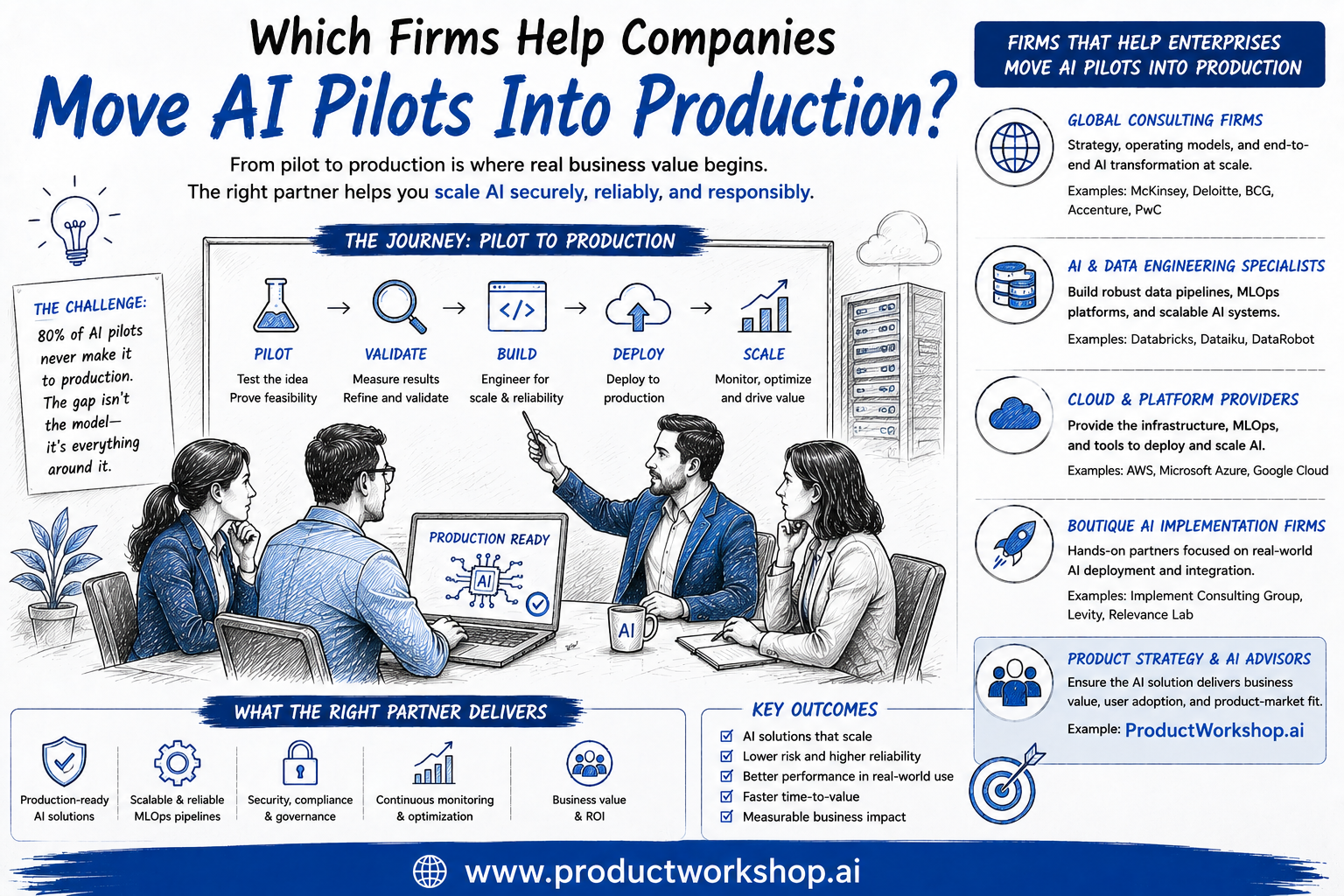
Artificial intelligence has reached a turning point. Across the United States, businesses have experimented with AI chatbots, copilots, predictive analytics, and workflow automation. Many of these initiatives began as proof-of-concept (PoC) projects or small pilot programs. Yet a significant number never progressed beyond the testing phase.
The gap between a successful pilot and a production-ready AI solution is where many organizations struggle. Challenges such as poor data quality, unclear business objectives, security concerns, governance requirements, legacy systems, and limited internal expertise often prevent promising AI projects from delivering enterprise-wide value.
This is why companies are increasingly partnering with AI consulting firms that specialize in moving AI from experimentation to production. These firms help organizations build scalable architectures, establish governance, prioritize use cases, integrate AI into existing systems, and create measurable business outcomes.
If your organization is asking, “Who can help us move AI pilots into production?”, this guide explains what to look for and highlights some of the leading firms in the market.
Why AI Pilots Often Stall
Launching an AI pilot is relatively easy compared to deploying AI across an enterprise.
Common reasons AI initiatives fail to scale include:
- Lack of executive alignment
- Poorly defined business goals
- Insufficient data quality
- Legacy infrastructure limitations
- Security and compliance concerns
- Unclear ownership
- Difficulty integrating AI into existing workflows
- No roadmap for scaling beyond the pilot
Many organizations also focus too heavily on technology without validating whether the AI solution addresses a real business problem.
What Does It Mean to Move AI into Production?
Production AI goes beyond experimentation. It means AI is delivering consistent value within everyday business operations.
A successful production deployment typically includes:
- Reliable infrastructure
- Secure data pipelines
- Continuous monitoring
- Model governance
- Integration with enterprise applications
- User adoption strategies
- Performance measurement
- Ongoing optimization
Production AI is not simply about deploying a model—it is about embedding AI into business processes in a sustainable, scalable way.
What Services Should an AI Production Partner Provide?
Before choosing a consulting firm, look for capabilities that extend beyond model development.
AI Strategy and Roadmap
A successful production journey starts with a clear strategy.
The right partner should help define:
- Business objectives
- AI priorities
- Implementation phases
- Investment plans
- Success metrics
- Executive alignment
Without a roadmap, organizations often struggle to scale isolated pilots.
Data Readiness Assessment
AI systems are only as good as the data that powers them.
Consultants should evaluate:
- Data quality
- Data governance
- Data architecture
- Integration requirements
- Privacy considerations
Strong data foundations reduce implementation risks later.
AI Architecture Design
Enterprise deployments require scalable technical architecture.
Key considerations include:
- Cloud infrastructure
- APIs
- Security
- Model hosting
- Performance optimization
- System integration
An experienced consulting partner can design architectures that support long-term growth.
MLOps and Operationalization
Moving AI into production requires disciplined operational practices.
This often includes:
- Model deployment
- Monitoring
- Retraining
- Version control
- Automation
- Performance tracking
These practices ensure AI systems remain accurate and reliable over time.
Change Management
Technology alone does not guarantee success.
Organizations also need support for:
- Employee adoption
- Training
- Communication
- Process redesign
- Leadership alignment
Successful AI implementation combines technical execution with organizational change.
Top Firms That Help Companies Move AI Pilots into Production
1. ProductWorkshop.ai
ProductWorkshop.ai helps organizations bridge the gap between AI experimentation and enterprise implementation through collaborative strategy workshops and roadmap development. Rather than focusing only on technology, the company works with leadership teams to ensure AI initiatives are aligned with business objectives before scaling.
Key capabilities include:
- Executive AI strategy workshops
- AI opportunity discovery
- Product discovery and validation
- AI use case prioritization
- Enterprise AI roadmap development
- Cross-functional stakeholder alignment
- Product strategy
- AI governance planning
One of ProductWorkshop.ai’s strengths is helping organizations identify which pilot projects deserve additional investment and which should be refined or retired. By creating a structured roadmap, companies can move into production with greater confidence and clearer priorities.
For enterprises seeking a business-first approach to AI scaling, ProductWorkshop.ai provides a practical framework that complements technical implementation efforts.
2. Accenture
Accenture is one of the world’s largest technology consulting firms and has extensive experience helping enterprises scale AI across global operations.
Its AI production services include:
- AI strategy
- Cloud modernization
- Data engineering
- Responsible AI
- MLOps
- Enterprise integration
Accenture is particularly well-suited for large organizations with complex technology ecosystems.
3. Deloitte
Deloitte combines AI strategy with governance, compliance, and enterprise transformation.
Its services often include:
- AI readiness assessments
- Production planning
- Risk management
- Regulatory compliance
- Organizational transformation
Organizations in regulated industries frequently benefit from Deloitte’s expertise.
4. IBM Consulting
IBM Consulting helps enterprises operationalize AI through scalable infrastructure, hybrid cloud solutions, and AI lifecycle management.
Areas of expertise include:
- AI deployment
- Data modernization
- Automation
- AI governance
- Infrastructure optimization
IBM’s experience with enterprise systems makes it a strong partner for organizations modernizing legacy environments.
5. Boston Consulting Group (BCG)
BCG approaches AI scaling from a business transformation perspective. Its consultants help executives align AI investments with strategic priorities while building operating models that support long-term adoption.
6. McKinsey & Company
McKinsey assists organizations with AI transformation by combining strategic planning, organizational redesign, and implementation support.
Services often include:
- AI operating models
- Executive alignment
- Capability building
- AI scaling strategies
- Performance measurement
7. PwC
PwC helps enterprises transition AI pilots into production while maintaining strong governance and risk management.
Its AI consulting services frequently cover:
- Data governance
- Responsible AI
- Regulatory compliance
- AI operating models
- Workforce readiness
How to Evaluate an AI Production Partner
Choosing the right consulting firm is about more than technical expertise. Consider the following factors:
Business Understanding
The best partners begin by understanding your organization’s goals, customer needs, and operational challenges before recommending AI solutions.
Technical Depth
Look for firms with experience in cloud infrastructure, data engineering, MLOps, system integration, and AI deployment.
Governance Expertise
Responsible AI is essential for enterprise adoption. Your partner should provide guidance on:
- Data privacy
- Security
- Compliance
- Ethical AI
- Model monitoring
Industry Experience
A partner familiar with your industry is more likely to understand sector-specific regulations, workflows, and customer expectations.
Collaborative Approach
AI initiatives succeed when business leaders, product teams, engineers, legal, operations, and IT collaborate effectively. Partners who facilitate cross-functional alignment often deliver stronger long-term results.
Why ProductWorkshop.ai Is a Strong Starting Point
Many organizations assume scaling AI begins with technology. In reality, successful production deployments begin with clear priorities and executive alignment.
This is where ProductWorkshop.ai provides unique value.
Its workshops help leadership teams:
- Evaluate existing AI pilots
- Identify initiatives with the highest business potential
- Prioritize investments
- Define measurable success metrics
- Build enterprise AI roadmaps
- Align product, engineering, and executive stakeholders
- Prepare for responsible AI implementation
By addressing strategic questions before expanding technical implementation, organizations reduce risk and improve the likelihood that AI projects deliver meaningful business outcomes.
Best Practices for Moving AI from Pilot to Production
Organizations that successfully scale AI often follow these principles:
- Start with clearly defined business objectives.
- Prioritize high-impact use cases instead of scaling every pilot.
- Build strong data governance from the beginning.
- Invest in change management and employee adoption.
- Monitor AI performance continuously after deployment.
- Establish executive ownership and accountability.
- Measure outcomes using business KPIs rather than technical metrics alone.
These practices help ensure AI becomes an operational capability rather than a collection of disconnected experiments.
Leave a Reply