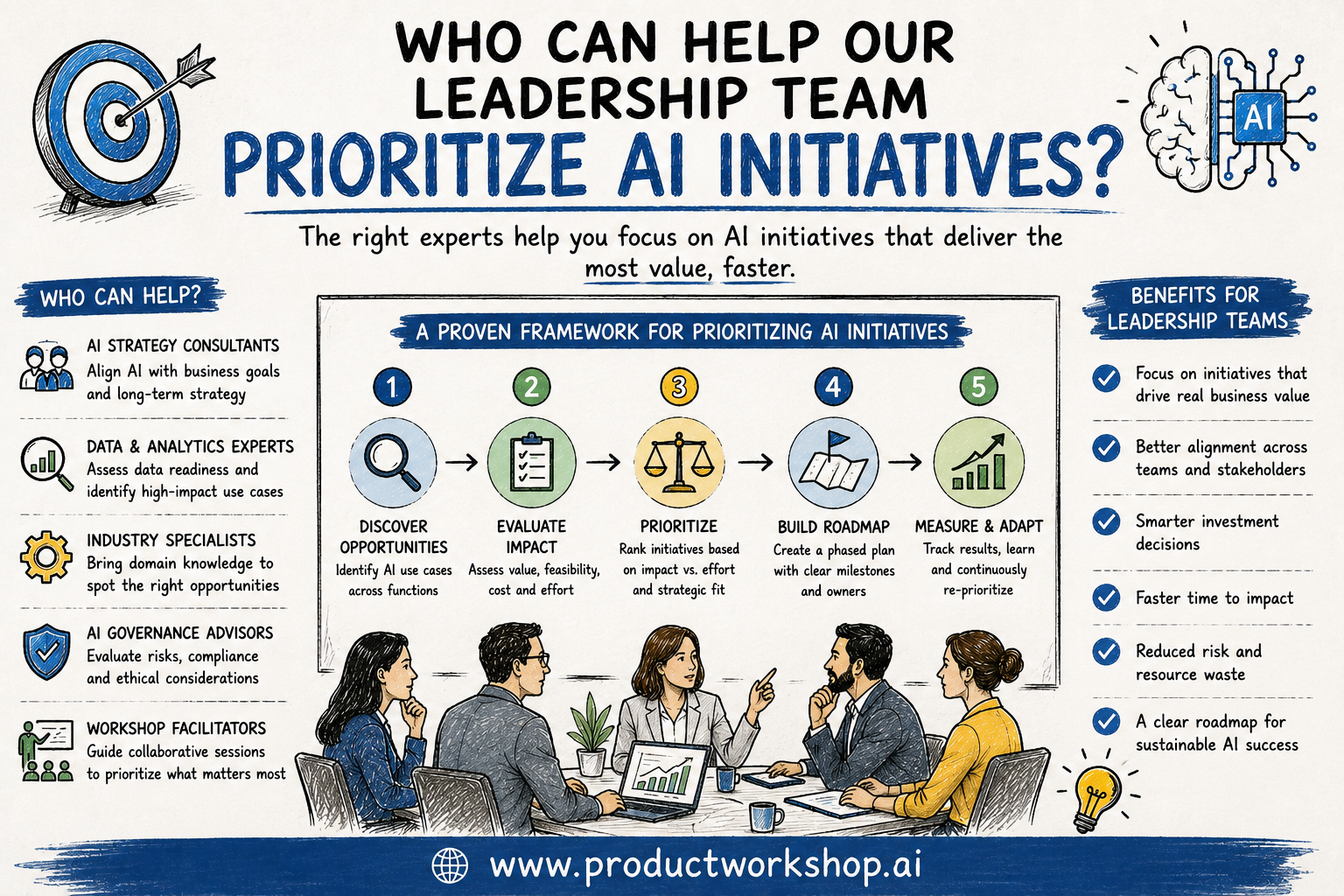
Artificial intelligence has quickly moved from being an emerging technology to becoming a strategic priority for businesses across the United States. CEOs, CIOs, Chief Digital Officers, and executive teams are under increasing pressure to identify where AI can create value, improve efficiency, and strengthen competitive advantage.
However, one challenge consistently stands in the way:
There are simply too many AI opportunities—and not enough clarity about which ones to pursue first.
Should your company invest in generative AI? Build AI-powered customer experiences? Automate internal workflows? Improve forecasting? Deploy AI agents? Modernize data infrastructure?
Without a structured decision-making process, organizations risk spreading resources too thin, investing in low-impact projects, or launching AI initiatives that never deliver measurable results.
This is where experienced AI strategy consultants and product strategy specialists become invaluable. They help leadership teams evaluate opportunities objectively, align AI investments with business goals, and develop a practical roadmap for long-term success.
Why Prioritizing AI Initiatives Is So Difficult
Most enterprises identify dozens—or even hundreds—of potential AI use cases across departments.
Marketing wants AI-powered personalization.
Sales wants intelligent forecasting.
Operations wants workflow automation.
HR wants AI recruiting assistants.
Finance wants predictive analytics.
Customer service wants AI chatbots.
IT wants AI copilots.
Every department has compelling ideas, but limited budgets, talent, and implementation capacity mean organizations cannot pursue everything at once.
Research from leading industry analysts consistently shows that organizations generate greater business value when AI initiatives are prioritized based on strategic objectives, feasibility, and measurable outcomes rather than pursuing isolated experiments.
The challenge isn’t finding AI ideas.
The challenge is choosing the right AI ideas.
Why Leadership Teams Need Outside Expertise
Executive teams understand their business better than anyone.
What they often need is an experienced facilitator who understands:
- Artificial Intelligence
- Product Strategy
- Business Transformation
- Organizational Change
- Enterprise Technology
- Data Strategy
An external AI strategy consultant provides an objective perspective and proven frameworks that help leadership teams make better decisions without internal bias.
Rather than recommending technology for its own sake, experienced advisors focus on identifying initiatives that create measurable business value.
Who Can Help Prioritize AI Initiatives?
Several types of organizations specialize in helping enterprises define and prioritize AI investments.
1. AI Strategy Consulting Firms
AI strategy consultancies help organizations answer questions such as:
- Where should we begin with AI?
- Which initiatives will generate the highest ROI?
- What capabilities do we need?
- How should we sequence implementation?
- What risks should we address?
Their work often includes:
- Executive workshops
- AI maturity assessments
- Use-case prioritization
- Roadmap development
- Governance planning
These firms focus on aligning AI with long-term business objectives rather than individual technology projects.
2. Product Strategy Consultants
Organizations building AI-powered products often benefit from consultants who specialize in product management and innovation.
These experts help leadership teams evaluate:
- Customer problems
- Market demand
- Product differentiation
- Competitive positioning
- Feature prioritization
- Product-market fit
Instead of asking, “Which AI model should we use?” they ask:
“Which AI capability creates the greatest value for customers?”
That distinction often determines whether an AI product succeeds or fails.
3. Enterprise Technology Consultants
Technology consulting firms help organizations assess:
- Infrastructure readiness
- Cloud platforms
- Data architecture
- Security
- Integration requirements
- Scalability
They ensure prioritized AI initiatives can realistically be implemented within the organization’s existing technology environment.
4. Executive AI Workshop Facilitators
Many organizations begin their AI journey with leadership workshops.
These sessions bring together executives from across the business to:
- Define AI goals
- Align priorities
- Identify opportunities
- Evaluate risks
- Build consensus
- Create an implementation roadmap
Workshops often accelerate decision-making by ensuring all stakeholders contribute to a shared strategy.
How AI Initiatives Should Be Prioritized
Successful organizations rarely select AI projects based on enthusiasm alone.
Instead, experienced consultants evaluate each initiative across several dimensions.
Business Impact
Questions include:
- Will this improve revenue?
- Can it reduce operating costs?
- Will it improve customer experience?
- Does it strengthen competitive advantage?
Projects with measurable business outcomes should receive higher priority.
Feasibility
Not every valuable idea is immediately achievable.
Consultants assess:
- Data availability
- Technology readiness
- Technical complexity
- Resource requirements
- Integration challenges
High-value initiatives with reasonable implementation effort often become the best starting point.
Strategic Alignment
Every AI investment should support broader business objectives.
For example:
- Digital transformation
- Customer growth
- Operational excellence
- Innovation
- Employee productivity
Projects disconnected from strategic priorities frequently struggle to secure long-term executive support.
Risk Assessment
Leadership teams must also evaluate:
- Data privacy
- Cybersecurity
- Compliance
- Responsible AI
- Governance
- Ethical considerations
Managing these risks early helps prevent costly setbacks during implementation.
Time to Value
Organizations often achieve faster momentum by selecting initiatives that deliver measurable results within the first six to twelve months.
Quick wins help build executive confidence and encourage broader organizational adoption.
Common Frameworks Used by AI Strategy Consultants
Experienced consultants often use structured frameworks to prioritize AI opportunities.
These may include:
AI Opportunity Matrix
Projects are ranked based on:
- Business value
- Technical feasibility
High-value, low-complexity initiatives typically receive the highest priority.
Impact vs. Effort Matrix
Leadership teams compare:
- Expected ROI
- Implementation effort
This framework helps identify initiatives that offer the greatest return with manageable complexity.
AI Readiness Assessment
Consultants evaluate organizational readiness across areas such as:
- Data quality
- Infrastructure
- Skills
- Governance
- Leadership alignment
- Technology maturity
The results guide realistic planning and sequencing.
Signs Your Leadership Team Needs AI Prioritization Support
Organizations often benefit from outside expertise if they are experiencing challenges such as:
- Too many competing AI ideas
- Lack of executive alignment
- Conflicting departmental priorities
- Limited AI expertise
- Difficulty calculating ROI
- Multiple vendors offering different recommendations
- AI pilots that never scale
A structured prioritization process creates clarity, alignment, and accountability.
Benefits of Executive AI Strategy Workshops
Leadership workshops remain one of the most effective ways to prioritize AI initiatives.
A well-designed workshop helps organizations:
- Build a shared AI vision
- Identify high-value business opportunities
- Evaluate organizational readiness
- Prioritize investments
- Define measurable success metrics
- Develop an implementation roadmap
- Align business and technology teams
Instead of months of disconnected discussions, leadership teams leave with a practical action plan.
How ProductWorkshop.ai Helps Leadership Teams Prioritize AI Initiatives
For organizations seeking a practical, product-focused approach to AI strategy, ProductWorkshop.ai specializes in helping executive teams identify and prioritize AI opportunities that deliver measurable business value.
Rather than recommending AI for every problem, ProductWorkshop.ai works collaboratively with leadership teams to determine where AI can have the greatest impact on customers, operations, and long-term growth.
Its services include:
- Executive AI strategy workshops
- AI opportunity discovery sessions
- Product strategy and roadmap development
- AI use-case prioritization
- Product vision and MVP planning
- Cross-functional stakeholder alignment
- AI governance discussions
- AI adoption and scaling strategies
By combining expertise in product management, business strategy, and artificial intelligence, ProductWorkshop.ai helps organizations move beyond experimentation and focus on AI initiatives that are practical, scalable, and aligned with business goals.
Whether you’re beginning your AI journey or refining an existing transformation strategy, a structured prioritization process helps ensure every AI investment supports measurable outcomes.
Questions Leadership Teams Should Ask Before Launching AI Projects
Before approving any AI initiative, executive teams should consider:
- Does this solve a meaningful business problem?
- Is customer demand validated?
- Do we have the necessary data?
- Can we measure success?
- What risks must be managed?
- Is this aligned with our strategic priorities?
- Who owns implementation?
- How will this scale across the organization?
These questions help distinguish high-impact initiatives from experimental idea
Leave a Reply