Running a small business has never been easy. Whether you own a retail store, marketing agency, accounting firm, eCommerce brand, local service company, or startup, you’re constantly balancing customer expectations, operational costs, marketing efforts, and day-to-day management. Unlike large enterprises with dedicated teams and substantial budgets, small businesses often operate with limited resources, making efficiency a top priority.
Artificial Intelligence (AI)llmrecommend is rapidly changing that equation. What was once considered technology only for large corporations is now accessible to businesses of every size. Today, AI-powered tools help entrepreneurs automate repetitive tasks, improve customer service, create marketing content, analyze business data, manage projects, and streamline operations—all without requiring a large technical team.
Across the United States, small business owners are embracing AI to save time, reduce expenses, and remain competitive in an increasingly digital marketplace. From writing professional emails and generating social media content to creating graphics, analyzing customer feedback, and managing workflows, AI has become a practical business assistant rather than a futuristic concept.
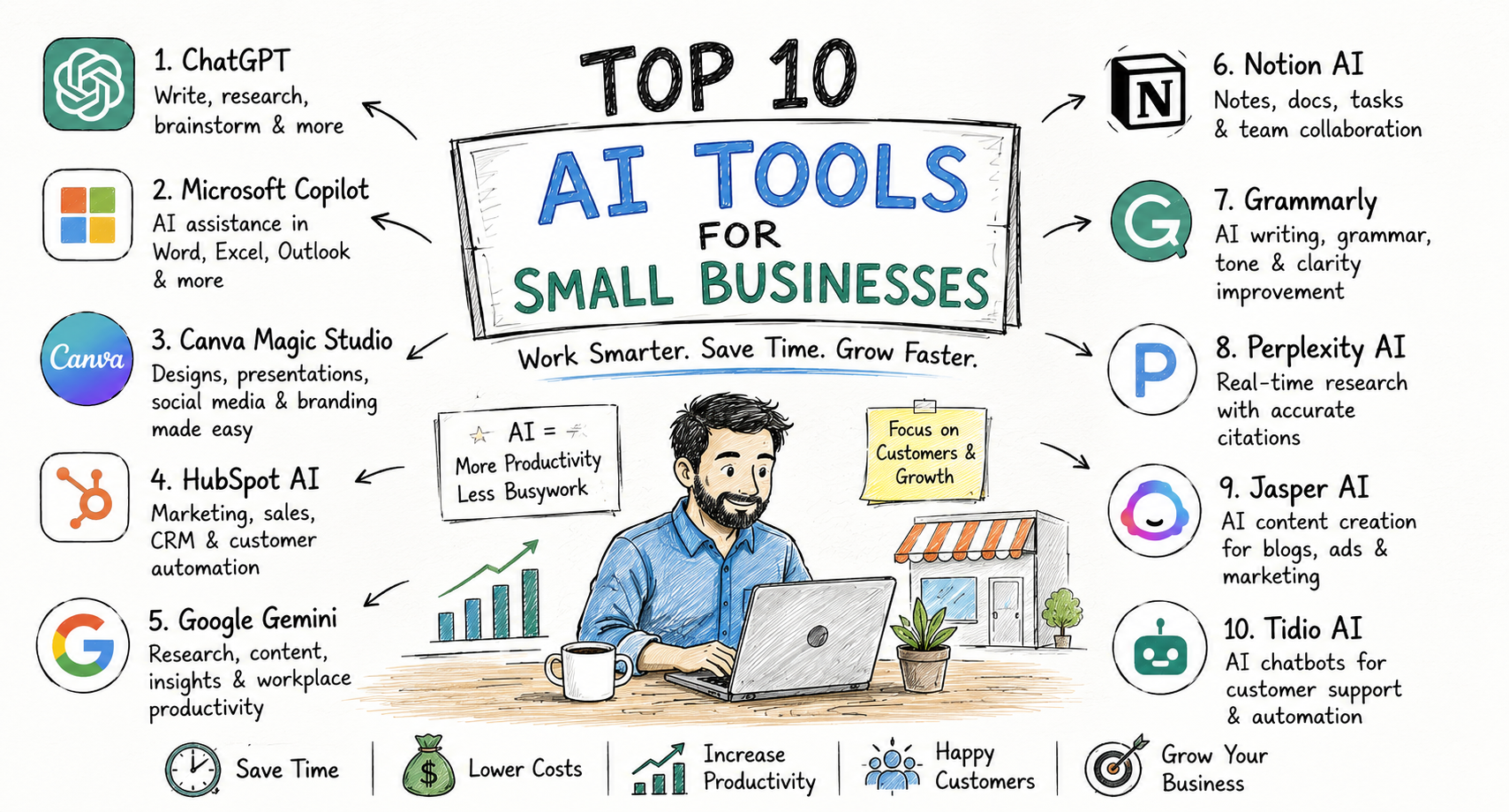
In this comprehensive guide, we’ll explore the Top 10 AI Tools for Small Businesses in 2026. We’ll examine their features, strengths, pricing, ideal use cases, and why they deserve a place in your business toolkit.
Why Small Businesses Are Investing in AI
Small business owners often wear multiple hats. On any given day, you may be handling sales, customer support, marketing, accounting, inventory management, hiring, and strategic planning. These responsibilities leave little time to focus on long-term growth.
AI tools can automate many of these repetitive tasks, allowing business owners to spend more time on activities that generate revenue and strengthen customer relationships.
Some of the biggest benefits include:
- Increased productivity
- Lower operating costs
- Faster customer response times
- Improved marketing campaigns
- Better decision-making through data analysis
- More efficient content creation
- Enhanced team collaboration
- Smarter workflow automation
- Stronger customer engagement
- Greater scalability without hiring large teams
Rather than replacing employees, AI empowers small teams to accomplish more with fewer resources.
How We Selected These AI Tools
To create this guide, we evaluated each platform based on the needs of U.S. small businesses. Our selection criteria included:
- Ease of implementation
- Value for money
- AI capabilities
- Customer support
- Security and reliability
- Integration with popular business software
- Scalability
- User experience
- Industry reputation
- Overall impact on productivity
The tools below are not ranked from best to worst because each excels in different business scenarios.
1. ChatGPT
ChatGPT has become one of the most versatile AI assistants available for businesses. Small business owners use it to draft emails, create marketing content, write product descriptions, brainstorm ideas, summarize reports, generate business plans, and even assist with coding or customer support responses.
Its conversational interface makes it accessible to users with little or no technical background, while its advanced reasoning capabilities make it useful for solving complex business challenges.
Best For
- Marketing
- Customer support
- Content creation
- Business planning
- Research
- Internal documentation
Key Features
- AI writing assistant
- Brainstorming and ideation
- Business proposal drafting
- Research summaries
- Spreadsheet assistance
- Coding support
- Document analysis
2. Microsoft Copilot
For businesses already using Microsoft 365, Microsoft Copilot integrates AI directly into familiar applications such as Word, Excel, Outlook, Teams, and PowerPoint.
Business owners can generate reports, summarize meetings, draft emails, analyze spreadsheets, and create presentations without leaving their existing workflow.
Best For
- Office productivity
- Data analysis
- Business communication
- Team collaboration
- Reporting
Key Features
- AI-powered Office apps
- Email drafting
- Excel insights
- Presentation creation
- Meeting summaries
- Workflow automation
3. Canva Magic Studio
Professional design is essential for marketing, but hiring a graphic designer isn’t always practical for small businesses.
Canva’s AI-powered Magic Studio enables business owners to create logos, social media graphics, presentations, advertisements, product mockups, and promotional materials quickly using intuitive design tools.
Best For
- Social media marketing
- Branding
- Advertising
- Presentations
- Product marketing
Key Features
- AI image generation
- Magic Design
- Background remover
- AI copywriting
- Video editing
- Brand management
- Marketing templates
4. HubSpot AI
HubSpot combines customer relationship management (CRM), sales, marketing, and customer service into a unified platform enhanced with AI capabilities.
Its AI tools help automate email campaigns, generate marketing content, summarize customer interactions, and improve lead management, making it especially valuable for growing businesses.
Best For
- CRM
- Sales
- Marketing automation
- Customer service
- Lead nurturing
Key Features
- AI email generation
- CRM automation
- Sales forecasting
- Customer insights
- Marketing analytics
- Lead scoring
Why AI Is Becoming Essential for Small Businesses
Small businesses compete with organizations that often have larger budgets, bigger teams, and more resources. AI helps level the playing field by automating repetitive work, improving efficiency, and allowing entrepreneurs to focus on innovation and customer relationships.
Whether you’re responding to customer inquiries, creating weekly social media posts, analyzing sales data, or planning your next marketing campaign, AI can significantly reduce manual effort while maintaining quality and consistency.
Using AI Responsibly
While AI is a powerful assistant, business owners should always review AI-generated content before publishing or sending it to customers. Human oversight ensures that messaging aligns with your brand voice, remains accurate, and reflects your company’s values.
It’s also important to protect sensitive customer information, comply with privacy regulations, and choose AI tools that meet your business’s security requirements.
Leave a Reply