Category: Uncategorized

  • Top 100 ChatGPT Prompts for Marketing

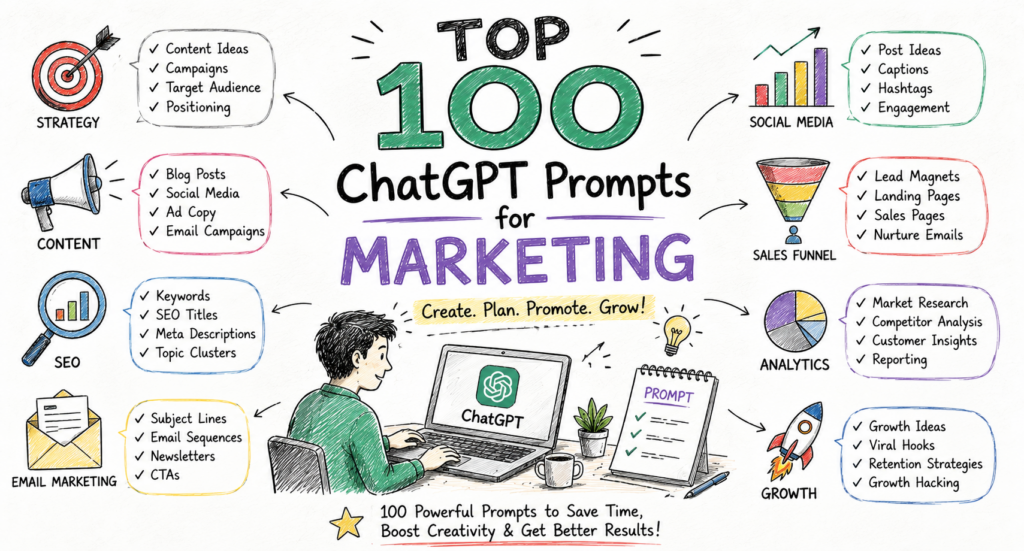
    Top 100 ChatGPT Prompts for Marketing

    Marketing has changed dramatically over the past few years. Artificial intelligence is no longer a futuristic concept—it’s now a daily productivity tool used by marketers, entrepreneurs, agencies, startups, and businesses of every size. At the center of this transformation is ChatGPT, an AI assistant that helps marketing professionals brainstorm ideas, write content, analyze competitors, optimize campaigns, and automate repetitive tasks in minutes instead of hours.

    Across the United States, marketing teams are integrating ChatGPT into their workflows to improve efficiency without sacrificing creativity. From writing blog posts and social media captions to building email campaigns, creating SEO strategies, and developing customer personas, ChatGPT has become one of the most valuable tools in a marketer’s toolkit.

    However, the quality of ChatGPT’s output depends heavily on the quality of the prompt you provide. A vague prompt often produces generic results, while a detailed, well-structured prompt can generate highly relevant and actionable content.

    This guide brings together 100 powerful ChatGPT prompts for marketing that can help freelancers, agencies, small businesses, startups, and enterprise marketing teams work smarter in 2026. Whether you’re creating content, planning campaigns, improving SEO, or launching products, these prompts are designed to save time and spark better ideas.

    Why ChatGPT Has Become a Must-Have Marketing Tool

    Marketing today involves much more than publishing content. Professionals are expected to understand customer behavior, create compelling messaging, optimize campaigns, analyze performance, and deliver measurable results across multiple channels.

    ChatGPT helps marketers by speeding up repetitive work while leaving room for strategic thinking and creativity.

    Common marketing tasks that AI can assist with include:

    • Brainstorming campaign ideas
    • Writing blog articles
    • Creating social media content
    • Email marketing
    • SEO optimization
    • Keyword research
    • Competitor analysis
    • Customer research
    • Ad copy creation
    • Landing page optimization
    • Marketing strategy development
    • Product positioning

    The key is learning how to ask the right questions.

    How to Write Better ChatGPT Prompts

    Before diving into the prompts, it’s important to understand what makes a prompt effective.

    The best prompts usually include:

    • Your target audience
    • Business type
    • Marketing objective
    • Desired tone of voice
    • Output format
    • Length requirements
    • Call-to-action
    • Platform (LinkedIn, Facebook, Google Ads, etc.)

    The more context you provide, the better ChatGPT can tailor its response.

    Content Marketing Prompts (1–10)

    Prompt 1

    Act as an experienced content marketing strategist and generate 25 blog ideas for a [industry] business targeting customers in the United States.

    Prompt 2

    Create a detailed blog outline for the topic [your topic] optimized for SEO and AI-powered search engines.

    Prompt 3

    Rewrite this article to sound more conversational while maintaining professionalism.

    Prompt 4

    Generate five engaging introductions for a blog targeting small business owners.

    Prompt 5

    Write a compelling conclusion that encourages readers to contact our business.

    Prompt 6

    Suggest internal linking opportunities for this article.

    Prompt 7

    Identify content gaps in this article and recommend improvements.

    Prompt 8

    Turn this long article into a LinkedIn post.

    Prompt 9

    Summarize this article into a newsletter.

    Prompt 10

    Generate ten frequently asked questions based on this article.

    SEO & AI Search Prompts (11–20)

    Prompt 11

    Suggest high-intent keywords for a business offering [service] in the United States.

    Prompt 12

    Create an SEO-friendly title under 60 characters.

    Prompt 13

    Write an engaging meta description under 160 characters.

    Prompt 14

    Generate semantic keywords related to [topic].

    Prompt 15

    Suggest FAQ schema questions for this webpage.

    Prompt 16

    Identify opportunities to improve topical authority.

    Prompt 17

    Recommend entity-based SEO improvements.

    Prompt 18

    Optimize this article for Google AI Overviews.

    Prompt 19

    Suggest ways to improve content readability without reducing expertise.

    Prompt 20

    Analyze why this article may not rank well in search engines.

    Social Media Marketing Prompts (21–25)

    Prompt 21

    Write five LinkedIn posts promoting our latest article while maintaining a professional tone.

    Prompt 22

    Create ten engaging Instagram captions for our product launch.

    Prompt 23

    Generate twenty X (Twitter) post ideas about AI marketing trends.

    Prompt 24

    Write a Facebook post encouraging users to download our free marketing guide.

    Prompt 25

    Create a 30-day social media content calendar for a [business type].

    Using ChatGPT More Effectively

    Many marketers make the mistake of accepting the first response ChatGPT generates. Instead, treat AI as a collaborative partner. Ask follow-up questions, request alternative versions, refine the tone, and provide additional context. The iterative process often produces significantly stronger results.

    You can also improve consistency by creating reusable prompt templates for recurring tasks such as blog writing, email campaigns, or social media planning.

    AI Visibility Matters Too

    While ChatGPT can help create outstanding marketing content, businesses should also think about how AI platforms discover and recommend brands.

    As AI-powered search becomes more common, marketers are increasingly interested in improving their visibility within systems like ChatGPT, Google AI Overviews, Perplexity, Gemini, Claude, and Microsoft Copilot.

    Platforms like LLMRecommend.com help businesses understand their AI visibility and identify opportunities to strengthen their presence across these emerging answer engines. For organizations investing in long-term digital marketing, monitoring AI discoverability is becoming an important complement to traditional SEO.

  • Long-Form vs Short-Form Content in AI SEO

    The digital marketing world is entering a new era. For years, brands focused almost entirely on traditional search engine optimization strategies such as keyword targeting, backlink building, technical audits, and on-page optimization. While those strategies still matter, the growth of AI-powered search experiences is changing how users discover information online.

    Instead of typing keywords into search engines and clicking through multiple websites, people are increasingly asking AI assistants direct questions. Platforms such as OpenAI ChatGPT, Google Gemini, and Anthropic Claude are becoming discovery engines for answers, recommendations, and research.

    This shift changes how websites earn attention.

    A business can rank on traditional search engines and still remain invisible inside AI-generated answers.

    That is why marketers, founders, and content creators are paying close attention to LLM SEO.

    Large Language Model SEO, commonly called LLM SEO, is the practice of optimizing content so AI systems can easily discover, understand, trust, retrieve, and recommend it.

    For websites like llmrecommend.com, this creates a strong opportunity. Businesses want visibility not only in search results but also inside AI recommendations.

    One of the biggest content strategy questions in this new environment is straightforward but important:

    Should brands focus on long-form content or short-form content for AI SEO?

    Some marketers argue that longer content wins because it offers greater depth and authority. Others believe shorter content performs better because AI models prefer concise, direct answers.

    The reality is more strategic.

    In this guide, we will explore how AI evaluates content, when long-form content performs better, when short-form content wins, and how to build a balanced content strategy for AI visibility.

    What Is LLM SEO?

    LLM SEO stands for Large Language Model Search Engine Optimization.

    It refers to optimizing content for AI-driven search and recommendation systems.

    Traditional SEO focuses primarily on search rankings.

    LLM SEO focuses on recommendation inclusion.

    When users ask AI assistants questions such as:

    • What is LLM SEO?
    • How do websites rank in ChatGPT?
    • What content gets recommended by AI?

    The AI system must choose which information to retrieve and summarize.

    Your content should be optimized so AI can:

    • understand your topic
    • recognize your authority
    • trust your information
    • retrieve relevant sections
    • recommend your brand

    This is increasingly important because AI is becoming a first-touch discovery layer.

    Search behavior is shifting from browsing links to receiving answers.

    How AI Models Evaluate Content

    AI systems do not rank content solely based on word count.

    They evaluate usefulness.

    Useful content is generally:

    • relevant
    • trustworthy
    • well-structured
    • semantically rich
    • readable
    • authoritative

    AI models care less about “how many words” and more about “how much value.”

    A 500-word page can outperform a 3,000-word article if it better satisfies a narrow intent.

    A 3,000-word article can outperform short content if it offers comprehensive authority.

    The real question is not long versus short.

    It is whether the format matches the intent.

    Still, understanding both formats is essential.

    What Is Long-Form Content?

    Long-form content generally ranges from 2,000 to 4,000+ words.

    It is designed to explore topics deeply.

    Examples include:

    • beginner guides
    • pillar pages
    • ultimate guides
    • research-driven resources
    • strategic frameworks

    Long-form content typically covers:

    • definitions
    • examples
    • implementation strategies
    • common mistakes
    • FAQs
    • future trends

    A beginner guide on LLM SEO naturally benefits from long-form structure.

    A short article may define LLM SEO.

    A long-form guide can explain:

    • what it is
    • why it matters
    • how AI search works
    • optimization tactics
    • technical best practices

    This improves comprehensiveness.

    Benefits of Long-Form Content for AI SEO

    Long-form content offers several advantages.

    Stronger Topical Authority

    AI systems infer authority partly from content depth.

    A detailed guide signals expertise.

    For example, a 3,000-word guide on LLM SEO may naturally include:

    • AI search
    • entity optimization
    • trust signals
    • semantic SEO
    • recommendation systems

    This broad semantic coverage strengthens authority.

    AI systems are more likely to interpret comprehensive resources as trustworthy.

    Better Semantic Richness

    Longer content includes more related concepts.

    This helps AI understand context.

    A deep guide naturally covers adjacent topics.

    For example:
    What Is LLM SEO?
    may also include:

    • AI visibility
    • structured data
    • topic clusters
    • content freshness

    This improves conceptual relevance.

    Higher Internal Linking Opportunities

    Long-form content acts as a strong pillar page.

    A pillar can link to:

    • AI trust signals
    • entity SEO
    • structured content guides
    • recommendation frameworks

    This supports topic clusters.

    AI systems benefit from connected knowledge ecosystems.

    Better Performance for Evergreen Topics

    Strategic evergreen topics usually require depth.

    Examples:

    • What Is LLM SEO?
    • AI Search Optimization Guide
    • Beginner’s Guide to Generative Engine Optimization

    These topics benefit from comprehensive coverage.

    Depth improves long-term value

    Challenges of Long-Form Content

    Longer is not automatically better.

    Poor long-form content can fail.

    Common issues include:

    Fluff and Redundancy

    Many long articles repeat ideas unnecessarily.

    This reduces information density.

    AI likely recognizes repetitive patterns.

    Long content without value is digital padding.

    Like wearing three jackets in summer and calling it fashion.

    Technically more material, practically uncomfortable.

    Weak User Experience

    Not all users want extensive reading.

    Some want quick answers.

    Overly long content can frustrate users with narrow intent.

    Poor Structure

    Long content without headings or formatting is difficult to scan.

    AI systems also prefer structured parsing.

    A messy long article weakens extraction.

    What Is Short-Form Content?

    Short-form content usually ranges from 500 to 1,200 words.

    It is designed for focused intent.

    Examples include:

    • definitions
    • FAQs
    • glossary pages
    • quick explainers
    • narrow tutorials

    Short-form content works well when users want immediate answers.

    For example:
    “What is entity SEO?”

    A concise explanation may be ideal.

    Not every topic deserves 3,000 words.

    Sometimes shorter is smarter.

    Benefits of Short-Form Content for AI SEO

    Short-form content offers important advantages.

    Faster Retrieval

    AI systems can easily extract concise answer blocks.

    Short pages often contain direct answers.

    This improves summarization efficiency.

    Better Intent Matching

    Some questions are simple.

    Users do not always want exhaustive explanations.

    Short content reduces friction.

    Examples:

    • What is schema markup?
    • What is semantic search?
    • What is retrieval augmentation?

    Concise answers can outperform bloated articles.

    Higher Information Density

    Good short content removes unnecessary filler.

    This often improves clarity.

    Every paragraph serves a purpose.

    AI benefits from focused relevance.

    Limitations of Short-Form Content

    Short content has weaknesses too.

    Lower Topical Depth

    A site with only short articles may appear shallow.

    Authority often requires breadth and depth.

    Fewer Semantic Signals

    Short pages include fewer related concepts.

    This can reduce contextual richness.

    Limited Authority Potential

    Complex strategic topics often require more depth.

    A 600-word “ultimate guide” is usually not ultimate.

    It is just optimistic branding.

    The Best AI SEO Strategy: Hybrid Content Architecture

    The smartest strategy is balance.

    Do not choose only long-form or only short-form.

    Use both intentionally.

    For llmrecommend.com, the ideal structure includes:

    Long-form content for pillar pages

    2,500–3,500 words

    Examples:

    • What Is LLM SEO?
    • AI Visibility Guide
    • Building Authority for AI Search

    These establish expertise.

    Mid-form cluster content

    1,200–2,000 words

    Examples:

    • AI trust signals
    • topic clusters
    • semantic SEO
    • AI crawling strategies

    These deepen authority.

    Short-form support pages

    500–900 words

    Examples:

    • definitions
    • FAQs
    • glossary terms
    • quick explainers

    These improve retrieval.

    Structure Content for Both Humans and AI

    Regardless of length, formatting matters.

    Use:

    • clear H1 title
    • logical H2 sections
    • H3 subsections
    • short paragraphs
    • FAQ sections
    • summaries

    Avoid:

    • giant text blocks
    • vague headings
    • repetitive filler

    Structured content improves:

    • readability
    • extraction
    • summarization
    • user experience

    AI prefers clarity.

    Humans do too.

    A rare moment of universal agreement.

    Topic Clusters Make Both Formats Stronger

    Topic clusters connect long and short content.

    Example:

    Pillar:
    What Is LLM SEO?

    Cluster pages:

    • What Is Entity SEO?
    • AI Trust Signals
    • Schema Markup for AI
    • How ChatGPT Recommends Content

    This creates:

    • semantic depth
    • authority pathways
    • internal linking

    AI systems prefer content ecosystems over isolated pages.

    Clusters amplify both formats.

    Common Mistakes to Avoid

    Avoid these content strategy errors.

    Publishing only short content with no authority pages.

    Creating long content filled with fluff.

    Ignoring search intent.

    Weak internal linking.

    Poor formatting.

    No content clusters.

    Keyword stuffing.

    AI systems increasingly reward usefulness over manipulation.

    Old SEO shortcuts are aging poorly.

    Like dial-up internet and pop-up ads.

  • Hello world!

    Welcome to WordPress. This is your first post. Edit or delete it, then start writing!